Tuesday, February 19, 2013

My Alabama Chanin Beaded Blue Bolero

My latest Alabama Chanin style masterpiece!


This is a beaded bolero from the Alabama Studio Sewing & Design book.
It's made from a single XL 100% cotton t shirt that I bought for $.99 at a Salvation Army. I placed the sleeve hem on the original sleeve hems. It's made from a single layer of fabric and stencilled in white fabric paint with the Paisely stencil that I downloaded here and stitched with silver lined bugle beads in two lengths and seed beads. I used the cretan stitch with smaller bugle beads to apply the binding. I also added a few swarovski lochrosen on the smaller dots in the paisely pattern.


I was inspired to make this project late last June as a run up to the fourth of July. I was seeing a lot of stars on blue clothing and liked that idea so I was originally thinking of using the star stencil, but in the end I thought that was a little too on-the-nose. I'm so happy with the way it turned out. It's very sparkly but the cotton makes it easy and comfortable. It's going to be a dress-up-or-down kind of garment. I can't wait till tank top weather to wear it! 


Some more info on the process:

The oak tag and mylar stencils used on my last projects where a PIA to cut! It took too long and hurt my hands.  I can confirm that the purchase price of a stencil from Alabama Chanin is totally fair and if I didn't want them all I would consider buying one. Alas, I can't afford them all so for this stencil I decided to try another material. I spent some time researching "pennant felt" as it is described in the books. I searched all over the interweb and was only able to locate it on the AC website. I figured "pennant felt" must be a term that they use to describe a product that is available under another name but I haven't found it yet. I did purchase some craft felt from Dick Blick but it turned out to be very soft and thick; too fluffy to be a good stencil. I don't like not having options, but I do like supporting Alabama Chanin so I caved and bought 1 yard from them.


It's thin and firm and easy enough to cut, although still fairly time consuming. It's also fairly wide so I'll be able to get 2 stencils out of the one yard. The first one is the paisely stencil and I'm still deciding on the next one. I was going to cut either Anna's Garden or the Facets but now that the lovely Heart stencil has been added to the resource page I am even more conflicted! Let me know if you have a  favorite.

The cheap spray bottle that I used to stencil my first projects was starting to sputter and splotch and I knew that I wanted to make more stencilled garments so I went ahead and purchased a Badger Airbrush.


It's a little strange to use at first but I'm getting used to it.  I will need to get a larger bottle though because the bottles it comes with are quite small and I had to refill them twice for a corset sized project. Yes, I have an embroidered corset project in the works!


Unfortunately (or fortunately??) I need to focus on my wedding dress at the moment so it won't get any work until this summer so look for it later this year!

Friday, December 14, 2012

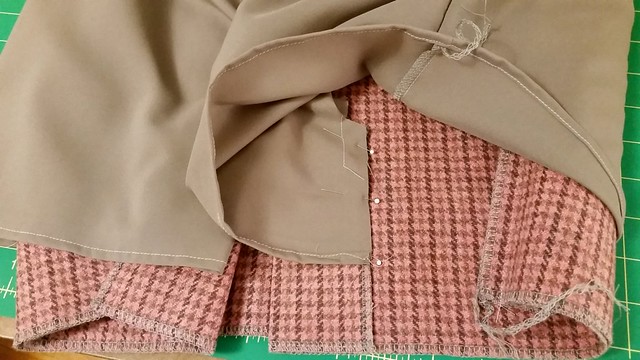
Sewing A Blazer

Order of Operations

- Bulk Fuse self pieces (except sleeve - fuse hem only).

- Cut Self and Lining.

- Mark button/hole placement on fronts with basting sts.

- Stitch fronts, back, shoulder, under collar/stand, sleeves as unit.

- Apply sleeve head and shoulder pad.

- Stitch top collar/stand, front facing, back neck facing together as unit.

- Stitch facing unit to body unit, breaking at the notch. Grade, & clip SAs. Under-stitch front, collar & lapel.

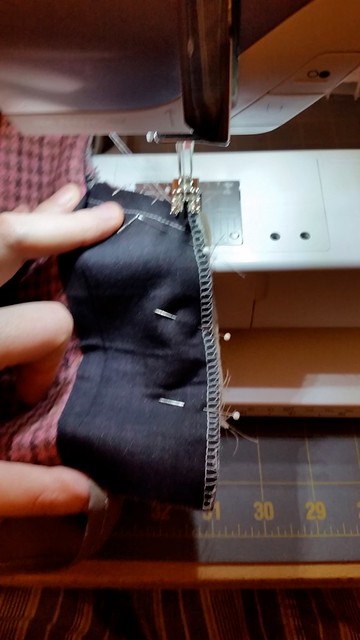
- Sew Jacket Lining completely; Serge body seams, serge finish the sleeve seams separately. Leave one sleeve seam open.

- Stitch sleeve hem to lining hem.

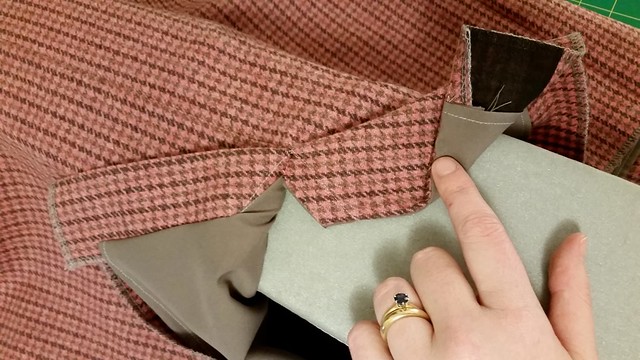
- Stitch lining to facing.

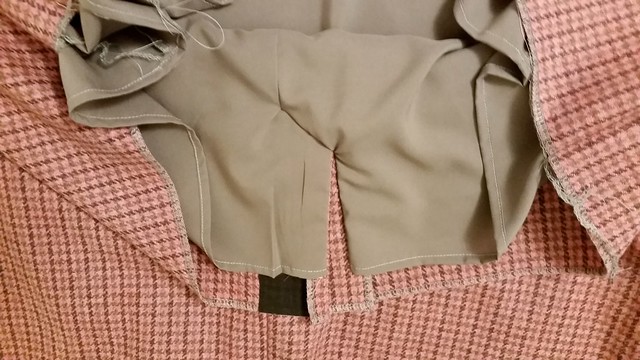
- Reach through lining sleeve seam to stitch bottom hem. Close sleeve lining.

- Stitch button holes, sew on buttons.

It should go without saying that one must press as you go.

Most Helpful Links:

- Sewing a notched collar: Threads This is not the method I use, but it looks pretty good. I should probably blog my method since I haven't found it's equivalent.

- Bagging a lining: Grainline , and Threads
  - Sleeve Vent: Pattern Scissors Cloth, Sigrid

Wednesday, December 12, 2012

Jacket Blazer Pattern Drafting Tips

Important things I learned about drafting jacket patterns:

  • The basic block rectangle is drafted using the CBL, and the bust measurement (wearer’s measurement +2~3” ease) divided by 2, +1”. Much of the excess ease will be drafted out when style lines are added.
  • Back HPS is 1 ¼” above CB neck.
  • Front HPS ¾” above CB neck, unless you are drafting for a larger than “average” bust. When doing a classic FBA adjustment length is usually added to a CF pattern piece. This can be avoided by raising the front HPS. I raised my front HPS to 2" above the CB neck. 
  • Shoulder slope is usually ½” lower than CB neck. adjusted front shoulder slope will differ accordingly.
  • Curve the shoulder seam toward the back for a nice shape.
  • The back shoulder seam gets 3/16” extra length than the front. This is in place of a shoulder dart.
  • The front armhole is longer than the back armhole by about ½” ~ 3/4”. About 5/8” excess is usually removed from the front armhole to achieve this, but the exact amount varies (ie: fuller or flatter bust).
  • Under lapel darts are used to eliminate the excess in the armhole for simple styles. They are not necessary for all styles.
  • Square collar stands are harder to sew than curved collar stands.
  • Seam allowances: neck/stand: 3/8”, stand/collar: ¼”, collar/lapel/front edge: 3/8”, AH/seams: ½”.
  • Pressing is VERY important to construction. When pressing the seam closed (prior to pressing seams open), steam can be used to stretch the seam allowances. This eliminates the need for clipping subtle curves and narrow darts.
  • Add 1/8" to collar and lapel points on front facing and top collar for turn of cloth (more depending on the thickness of the fabric). Blend to 0 at the notch and to the lapel break point. The top collar should also have 1/8" turn off cloth along the fall edge.
  • The Lapel should have 3 notches: the break point notch, 2" above the break point, and 2" bellow the lapel point. The facing should have corresponding notches, but the notch above the break point should be shifted up 1/8". This builds extra ease in above the break point to help the lapel roll correctly.
  • Do not tape the roll line if it is not needed (if the jacket does not gap) as this may cause the front to be shorter than the facing which can cause excess fabric (wrinkles) in the lapel roll line.

Wednesday, November 28, 2012

Drafting a Personal Fit Jacket – aka Pattermakers Block


I have been taking a patternmaking course at FIT this fall specializing in jackets and coats. Every week, we practice drafting the jacket block for a standard size 8 and learn how to create different jacket styles by changing the style lines. The class is from a production point of view, so there are lots of patternmaking details, tricks and methods to remember that will help make the construction more efficient and how and wear to adjust the fit when making pattern corrections. It’s been great. The weekly practice of drafting the block has finally sunk in and I sewing up the half muslin in less time each week. Practice makes better!

So now I’m starting to work on my final project and I have immediately run into a BIG problem. The final has to be of our own design, include the complete production pattern (w/ separate lining pieces, fusible, and templates) AND be accompanied by a full garment sample (we are allowed to employ a sample maker if we like). It’s also due in exactly two weeks. The amount of time and the scope of the project isn’t the problem. The problem is that we are allowed to use our own measurements for once, and of course if I’m going to go to all that effort I want to make the final sample wearable for myself.

Why is this a problem? Because I have a massive bust circumference (43”) and I carry a large portion of it on the front half of my torso. My front bust circ is 5” larger than my back. When we draft a block for jackets we place the side seam directly in the middle, which would make the back too big and the front too small, and give my a badly shaped back armhole to boot. This was never a problem as long as I was drafting for a size 8 (which apparently my back is). I am stumped on how to proceed and time is ticking away. Do I move the side seam closer to the back? Or do I draft the block based on my upper bust measurement and then adjust the bust as I would the hips when I add in my princess seam style lines? The later is closer to what I do with commercial patterns, but is a bit of a work around and defies the concept of drafting from scratch. I feel that there must be a right way of drafting this particular fit problem.

I was hoping my boss would be in the office today (he's also my professor - gotta love FIT) so I could pop into his office and ask him for 2 minutes of advice but unfortunately he is not here today, which means I am wasting another day that I could be working on the final.

Wednesday, September 26, 2012

Alabama Chanin: Green Tunic Tank

  I've been wanting to post pictures for a while now. Here they finally are.


This top is super comfortable and flattering.
I thought I was going to do a bunch of embroidery, but I was undecided about what and how much, so I stopped after stitching the first stem. I left the stitching because it tells me which side is the front. Otherwise I really wouldn't be able to tell because the pattern pieces are very similar.

I am bustier than my form, so on my the shoulder seam pulls to the front.
Next time I use this pattern I will cut off 1 inch from the back shoulder so that the back pulls the front up a bit. I will probably raise the front neckline a little as well.  

I love the herringbone stitch so I used it to flat fell the seams open and to bind the edges. 
 And there you have it. I'm hoping to make a more involved piece soon with my new airbrush and a larger stencil. I'll be sure to post about that when it happens. 

Tuesday, September 25, 2012

Chanel Jacket: Part 4: New Muslin, Quilting Prep


I cut and fit the new muslin last week. This time I make a size 16. I ended up making the same FBA to the front by adding 3/8” to the front princess seam allowances from hem and then blending in to the seam just above the bust curve. It fits just fine. I don't have a pic at the moment though.

This weekend I fit the sleeve. It was tight across the bicep and didn’t have much movement. I checked the measurement and noticed that the bicep measurement on the pattern piece (15 1/8”) is not correct. The bicep actually measured 14 ¾”, so there’s that. My bicep is 13 ½” but 2” ease is the suggested minimum (according to my Jacket’s & Suits patternmaking professor). Also worth noting: the “step” on the elbow seam of the upper sleeve is too low. I corrected it by matching the dots and redrawing the step. BTW, the step is used in production patterns to line up the top of the elbow seam. Both sleeve pieces should have steps on the top of the elbow seam that match perfectly so that you can line up the first part of the seam easily. The dots aren’t even necessary with a correct step, but I digress. I had been contemplating just going with the 2 piece sleeve but since I’d have to adjust it to fit anyway I figured I might as well make it into a 3 piece sleeve; more on that later.


Since I have the new Clair Schaeffer pattern I decided to trace the 3 piece sleeve onto muslin and give it a try. It has more room in the bicep but there is a LOT of sleeve cap ease; too much for the body. I suppose it could be the fact that it doesn’t really belong to the pattern body, but I wouldn’t know unless I muslin that body which I am not going to do at this time. The interesting thing about this sleeve is that all three pieces are quite curved. When the constructed sleeve is laid on a table it doesn’t lie flat and the wrist pops up. Basically the sleeve is shaped to mimic the way our arms naturally curve forward and inward. The curve of the outer seam is so pronounces that I think it makes the arm looks very rounded, which I don’t like. I want slim looking arms please! I think the “odd” grain-line on the front sleeve is intentional to get the grain to appear straight on the front of at the shoulder and especially at the third seam, but the curve kind makes this a moot point. I think it was worth trying and I wouldn’t write it off if I were to make the Claire Schaeffer pattern later.

So back to original 2 piece sleeve which I transformed into a 3 piece and increased the bicep approximately 1 ½” total. To do this first marked the bicep line and then I split the upper sleeve in half vertically (parallel to the grain-line) from the shoulder seam notch and then gently curved the line toward the front below the elbow so that it bisected the wrist in the middle. I taped each half to some extra paper and then added 5/8”~3/4” at each bicep point and used my hip curve to blend into the shoulder point and wrist. Then I added the canted sleeve vent under-lap on the back piece. I haven’t yet, but before I cut the fashion fabric I will cut muslins of this new sleeve and to check the fit once again.


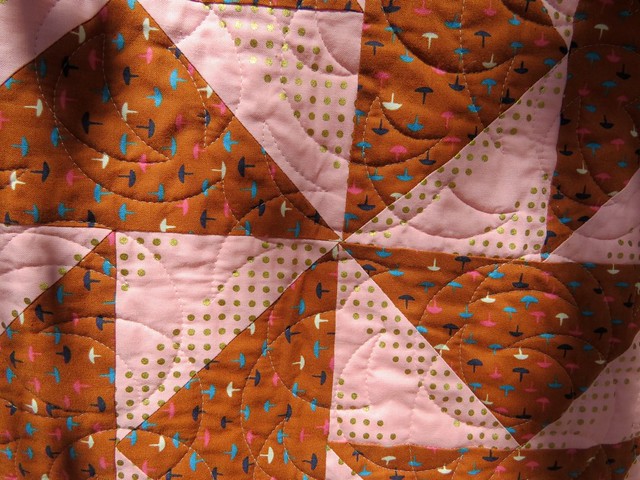
In the meantime, I’m preparing the body panels for quilting. This involves 1) thread tracing the pattern piece using a single strand of red dmc embroidery thread; 2) placing a silk organza armhole stay under the side front and back panels; cutting a square of silk jacquard lining and pinning it to the underside of each panel being careful to preserve the grain-line of all pieces. I got all 4 armhole panels completed last night so I think I should be able to do the center back and center fronts tonight. Then I will move onto the quilting phase!


I am super excited about the quilting part. It means I will finally get to justify my walking foot purchase (although I already used in on a mini quilt) and I’ll get to see how the hand of the fabric changes when the lining layer is added.


I also got out my trim again and started looking at it on top of some pieces of bias that I cut. It makes me very excited about this project!! I’m trying to be cool about it though. I don’t want any perceived setbacks to ruin the rhythm I’ve got going on.

Friday, September 14, 2012

Update: I've been busy


Just checking in for an update. No time for pics, just details:

Slow Sewing:
I managed to finish my Alabama Chanin green tunic/tank and a plain grey corset tank. I made everything in the XL size, and I think they may be a bit too loose for plain and moderately embroidered styles. Next time I think I need to take at least ½” off the back shoulders because the seam very forward on my shoulders (my back is kinda flat, my front is not so much) as well as raise the front neckline 1”. In the pipeline for the Alabama Chanin slow sewing is a blue sleeveless bolero and a pink retro panty and bustier set (burdastyle pattern). After a fruitless search of the interweb I ordered a yard of the pennant felt from Alabama Chanin which is slated to become a Paisley stencil and an Angie’s Fall stencil. I also bought a craft airbrush. 

Sew-Sew Summer:
I made a few dresses this summer to varying degrees of satisfaction. Hazel, which has a weirdly shaped facing (size 12 - am I the only one?) does not flatter me but the fabric is awesome and I wear it anyway. I also made a Tiered Maxi dress with that burdastyle pattern that is so popular. The fabric is a delicious Italian cotton floral, but without trim looks a bit like a nightgown. Also, the side zipper itches my tender flesh and is kinda unnecessary since I can pull the dress on over my head. I need to pick the zip out but the side seams will be different which bugs me. I want to make another version; short, no zip from a rayon challis floral with some wee trim at each tier. I cut a BS Fatima dress, but the fabric is noisy so I’ve lost interest half way through sewing it. I also cut a long striped jersey maxi dress but I need to take it in at the side seams (damn Big4 sizing again!) and it’s tricky to get the stripes to match up the 2nd and third time I stitch the side seams.

Chanel Jacket Update!
I attended a 90 minute “class” at Mood NYC this week with Susan Khalje where she went over the methods employed in making a classic french cardigan jacket. The class was very informative but I didn’t learn a whole lot of new information. I did find it helpful to go over everything in detail with a master couturier and I immediately got my Chanel jacket mojo back after seeing several ladies try on Susan’s famous samples. I brought both of my patterns to the class and Susan mentioned that she prefers the v7975 pattern to the newer v8804 pattern due to the built in shaping in the pattern. She said it is possible to convert a 2 piece sleeve into a 3 piece by splitting the upper sleeve vertically from the shoulder notch. She also discussed the dimensions and shape of the canted sleeve vent. Also worth noting; Susan uses silk organza to interline the top portion of the side front and back panels in order to stabilize the armholes. Overall I felt encouraged that the techniques employed, although labor intensive, are not terribly hard or complicated. No need to over think it. I confess, the pattern instructions in v8804 intimidated me with its specificity and additional construction techniques.

ETA: I found an AMAZING flicker set for the new Vogue pattern 8804. It makes me want to give that pattern a muslin. I think the sleeve is intriguing. Much of the online discussion about this pattern has been in regard to the "strange" grainline of the front top sleeve pattern piece however Claire Schaeffer herself weighs in on the subject in this flicker set!

Moving onward; last night I decided to remake my muslin in a larger size (16) using more traditional couture methods which I learned from Susan’s Craftsy couture dress class. One tip I will share is how I was able to easily transfer the pattern to the muslin. I have a Clover tracing wheel that has two adjustable wheels. The wheels are blunt so they don’t pierce or otherwise damage the tissue pattern. I set up the wheels 5/8” apart so that as I traced along the cutting line with the outer wheel the inner wheel traced the all important stitching line. This made it possible to skip drawing the cutting lines onto each pattern piece. I’m going to fit the sleeve as a two piece but I will draw the vertical seam line on it so I can check the placement.

Confession: I also bought a black tweedy boucle, complimentary silk charmeuse and thread for a 2nd Chanel jacket for fall. I will need to find appropriate trims later.

Knitting:
I participated in the Ravelympics, no wait, EXCUSE me, the Ravellenic Games. I did not medal (drat!) but I did finish my sweater. I love it, but I have no acceptable photos for the blog. Ravelers can check it out on ravelry.

I impulsively started a traditional aran fisherman sweater (stash busting, I swear) and I am already on the 2nd sleeve. It’s interesting and easy enough; great for tv knitting and commuting.

I need to cast on for me wedding shawl (to say nothing of my DRESS) but I am distracted by my current intarsia obsession. It’s all Kafe Fassett's fault. I found a 2nd hand copy of Glorious Knits and I am dying to make a carpet patterned (kilim inspired) cardigan jacket for fall. I’m going to Lion Brand Yarn Studio this evening for an event. I might end up purchasing a sweater worth of Amazing. If I do, it’s allowed because I finished my Ravellenic sweater with stash yarn and my current sweater is also stash yarn.

Studies:
I got an A in Patternmaking II. Hurrah! I am now enrolled in Patternmaking Jackets and Suits for the Fall semester at FIT. Learning to fit a jacket is supper helpful for work and especially for the Chanel jacket project. I am much more confident about fitting the new muslin. Two of the important things that I've learned so far are: 1) the Shoulder Slope is critical to the overall fit of the jacket, and 2) the Collar Sweep (outer edge of the collar) is critical to the shape and break of the lapel. If the collar sweep is too long, the lapel will break too high, if the sweep is too short, the lapel will break too low.
Related Posts Plugin for WordPress, Blogger...